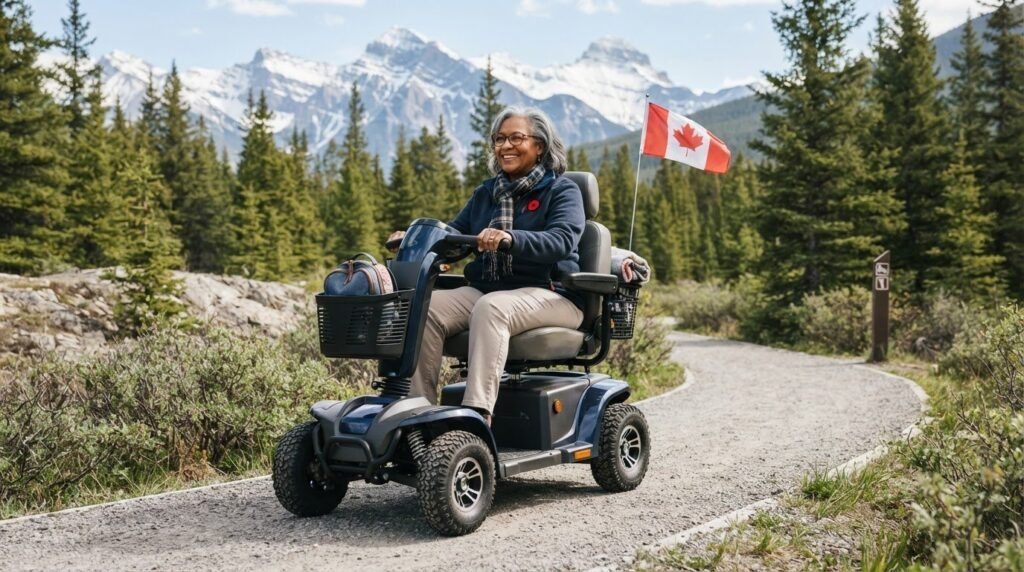
What if your mobility aid didn’t just move you around the house, but actually gave you the freedom to tackle a Canadian park trail or a gravel driveway without a second thought? Many people assume a standard travel unit is enough. They often end up facing the anxiety of a tipping hazard on uneven ground or a battery that drains far too quickly. Finding a reliable heavy duty scooter rental is about more than just extra weight capacity; it’s about reclaiming your confidence on every surface you encounter. You shouldn’t have to worry if your equipment can keep up with your lifestyle or support your physical requirements safely.
This guide helps you understand the technical side of bariatric support and stability so you can choose a unit that fits your needs. You’ll discover how a 4-wheel configuration provides the balance necessary for outdoor independence. We’ll break down everything from battery range and weight limits to the logistics of transporting larger units like the rugged BAJA® BANDIT. By the end, you’ll have a clear path to securing a rental that offers both durable performance and the comfort you deserve.
Key Takeaways
- Learn why reinforced frames and higher weight capacities are essential for bariatric support and navigating rugged outdoor terrain safely.
- Understand the role of advanced suspension systems and high amp-hour batteries in maintaining comfort and independence throughout the day.
- Compare technical specifications to decide if a heavy duty scooter rental is necessary for your weight requirements and typical driving surfaces.
- Discover practical logistics for your rental, including how to measure doorways and storage spaces to accommodate larger, more powerful units.
- Identify the specific advantages of the 4-wheel BAJA® BANDIT for maintaining stability and agility in diverse Canadian environments.
What Is a Heavy Duty Scooter Rental?
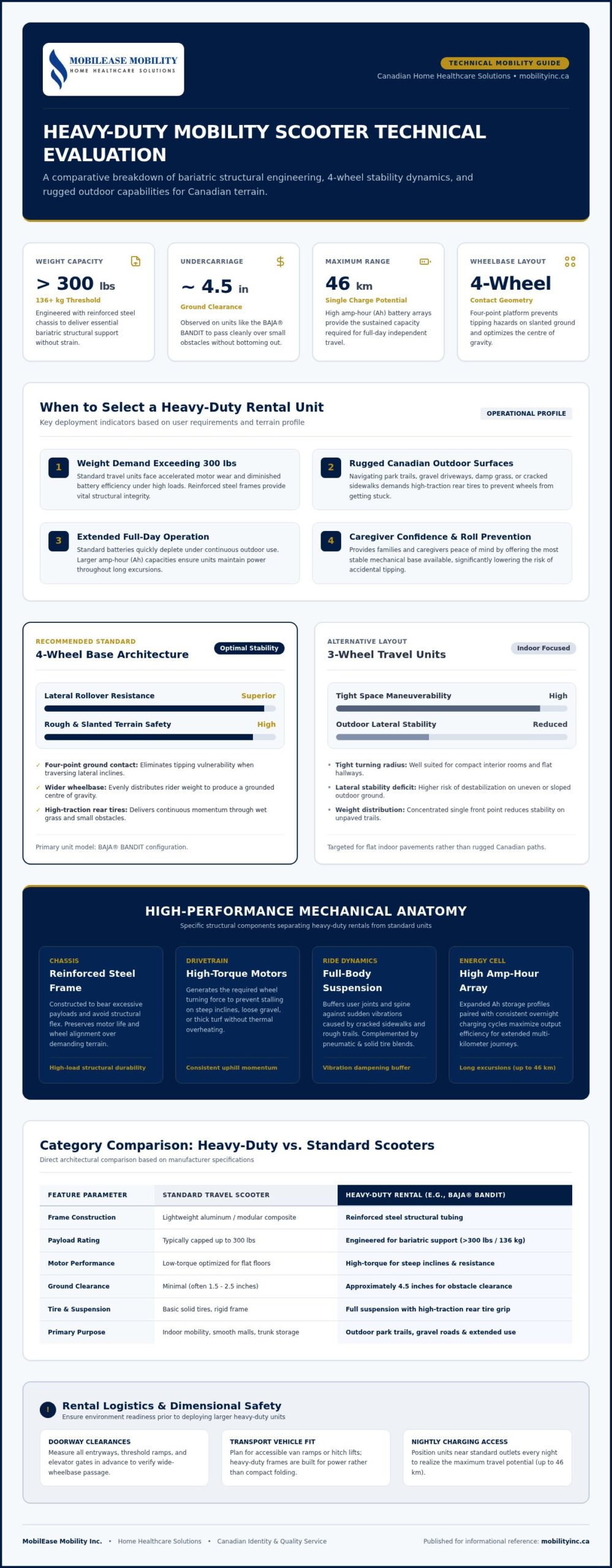
A heavy duty scooter rental refers to a specific category of equipment engineered for durability and high weight capacities. While standard mobility scooters are often designed for indoor use or smooth pavements, heavy-duty units feature reinforced steel frames and powerful motors. These machines are built to handle heavier loads without compromising motor longevity or battery efficiency. They bridge the gap between basic mobility and total outdoor independence.
The primary purpose of these units is two-fold. First, they provide essential bariatric support for users who require a higher weight rating than a standard travel unit offers. Second, they’re designed for rugged outdoor navigation. Unlike lightweight models that prioritize portability, a heavy-duty unit focuses on power. This ensures the motor doesn’t strain when climbing a hill or moving across soft grass. Choosing a heavy duty scooter rental means you’re prioritizing safety and performance over compact storage.
Who Should Consider a Heavy-Duty Option?
Selecting the right equipment depends on your specific physical needs and where you plan to go. You should consider a heavy-duty model if any of the following apply:
- Weight Requirements: If the user weighs more than 300 lbs (136 kg), a reinforced frame is necessary for safety.
- Outdoor Terrain: If you plan to visit parks with gravel paths, grassy areas, or uneven sidewalks, standard wheels may get stuck.
- Extended Use: Users who need to be out all day benefit from the larger batteries typically found in these units.
- Caregiver Peace of Mind: Families often choose these models to ensure their loved ones have the most stable platform possible, reducing the risk of accidents.
The Importance of 4-Wheel Configurations
Stability is the most critical factor for outdoor mobility. Most heavy-duty rentals, such as the BAJA® BANDIT, utilize a 4-wheel design. This four-point contact system provides a significant safety advantage by preventing the unit from tipping on slanted ground. While a 3-wheel scooter has a tighter turning radius, it lacks the lateral stability required for uneven surfaces.
A wider wheelbase also helps distribute weight more evenly. This design choice improves the centre of gravity, making the ride feel grounded rather than bouncy. Additionally, these units often feature larger, high-traction rear tires. These tires provide the grip needed to move through damp grass or over small obstacles without losing momentum. For Canadians facing varied weather and terrain, this configuration is the gold standard for a heavy duty scooter rental.
Key Features of High-Performance Rental Scooters
High-performance models offer more than just a higher weight capacity. They integrate specialized engineering to ensure the rider remains comfortable during long periods of use. When you select a heavy duty scooter rental, you’re choosing a machine designed to absorb the shocks of the road and provide consistent power. These features aren’t just luxuries; they’re essential for anyone who plans to spend significant time outdoors or on varied surfaces.
Suspension and Tire Technology
Comfort starts where the scooter meets the ground. High-performance rentals often feature a mix of tire types. Solid tires are puncture-proof and ideal for flat surfaces, while pneumatic (air-filled) tires offer superior shock absorption on rougher paths. To protect your spine and joints, look for units with full-body suspension. This system acts as a buffer against vibrations from cracked sidewalks or gravel trails. Ground clearance is the distance between the undercarriage and the floor. For example, the BAJA® BANDIT offers approximately 4.5 inches of clearance, allowing it to pass over small obstacles without bottoming out. These features are critical for maintaining safety and following ADA requirements for power-driven mobility devices when accessing public facilities and outdoor spaces.
Battery Life and Motor Torque
Motor power is measured by torque, which is the force required to turn the wheels. Heavy-duty units utilize high-torque motors to handle steep inclines and bariatric loads without overheating. A standard travel scooter might stall on a hill, but a high-performance rental keeps moving. Battery capacity is equally important. These units use larger amp-hour (Ah) ratings to support their powerful motors and extended range. You can realize the maximum range of your unit by following consistent charging habits, such as plugging it in every night. Some models can travel up to 46 km on a single charge, providing the reliability needed for a full day of independent travel. If you’re planning a long excursion, it’s worth checking the available high-capacity models to ensure your equipment matches your itinerary.
Seating is another area where high-performance units excel. Bariatric-rated seats are wider and more cushioned than standard versions. They typically include adjustable headrests and padded armrests that flip up for easier transfers. These ergonomic adjustments help prevent fatigue and pressure sores, making it possible to spend several hours in the seat comfortably. A well-fitted seat ensures that the user stays securely positioned, especially when the scooter is in motion over uneven ground.
Heavy Duty vs. Standard Scooters: A Comparison
Selecting a heavy duty scooter rental requires an understanding of how these units differ from standard travel models. The most immediate distinction is weight capacity. A standard scooter typically supports up to 250 lbs (113 kg), which is sufficient for light indoor use. In contrast, heavy-duty units are engineered for 400 lbs (181.4 kg) or more. This extra capacity isn’t just about the user’s weight; it’s about the frame’s ability to withstand the stresses of outdoor travel without bending or breaking. You’re paying for a reinforced structure that provides a safer margin for daily activities.
Speed and motor efficiency also set these categories apart. Standard units usually top out at around 6 km/h. Heavy-duty models like the BAJA® BANDIT reach speeds of up to 12.8 km/h. This increased speed is paired with higher motor torque. While a standard motor might struggle or overheat on a modest incline, a heavy-duty motor maintains consistent power. This efficiency is vital when navigating the varied topography of Canadian parks or community centres. You won’t have to worry about the machine stalling when you need it most.
Transportability is a major consideration for many families. Standard travel scooters often feature folding mechanisms or extremely light components. Heavy-duty units are larger but often utilize feather-touch disassembly. This allows the scooter to be broken down into manageable pieces, though the heaviest component can still weigh around 71 lbs (32.2 kg). Understanding these logistics is crucial when traveling with mobility assistive devices, as you must ensure your vehicle or transport service can accommodate the weight and size of the disassembled unit. For a broader overview of equipment options and booking considerations across the country, the complete guide to mobility scooter rental in Canada covers everything from compact folding models to heavy-duty outdoor units.
Performance on Varied Terrain
Standard models often struggle on soft surfaces like mulch, tall grass, or damp soil. Their smaller wheels and lower ground clearance cause them to bottom out or lose traction easily. Heavy-duty units solve this with larger tires and specialized anti-tip wheels. These safety features provide a wider base of support, ensuring the unit remains upright even when traversing a curb or an uneven path. The trade-off is a larger turning radius. While a standard unit might turn in a tight space; a heavy-duty model often requires 53 inches. This extra space is the price of increased stability and safety.
User Comfort and Dimensions
Physical comfort is where the heavy-duty category truly excels. Standard seats are usually 18 inches wide with basic padding. Heavy-duty rentals provide bariatric seating options that start at 22 inches. Many units feature high-back captain’s chairs with adjustable headrests. These seats offer the spinal support needed for long-term use during a full day of activities. Taller users also benefit from larger frames that provide significantly more legroom. This prevents the cramped posture often associated with smaller models, allowing for a more natural and relaxed driving position.
Planning Your Rental: Logistics and Safety
Securing a heavy duty scooter rental requires more coordination than a standard unit due to the size and weight of the equipment. Preparation ensures that the device integrates seamlessly into your daily routine without causing home-entry issues. Following a methodical planning process helps you avoid common pitfalls associated with larger mobility aids.
- Step 1: Measure Your Space. Heavy-duty units are often wider and longer than travel models. Measure your front door, hallway widths, and any storage areas. Ensure there is enough room for the 53-inch turning radius mentioned in previous sections.
- Step 2: Set Your Timeline. Determine if you need the rental for a short-term recovery or an extended travel period. Many providers offer weekly or monthly rates that are more cost-effective for long-term needs.
- Step 3: Plan for Transport. Decide how you will move the scooter between locations. This often requires specialized vehicle equipment like ramps or an accessible van.
- Step 4: Inspect on Delivery. When the unit arrives, test the brakes, verify the battery is fully charged, and ensure the lights are functional. Confirm the seat adjustments work for your specific height and weight.
Transporting a Heavy-Duty Unit
One of the biggest challenges with high-capacity scooters is their physical footprint. These units typically don’t fit into the trunk of a standard sedan, even when disassembled. The individual pieces are often too bulky for a traditional car. Most users rely on SUVs, minivans, or vehicles equipped with hitch-mounted lifts. If you’re using a personal vehicle, portable ramps can facilitate loading without requiring you to lift the heaviest components. Always use tie-down straps to secure the scooter during transit. This prevents the frame from shifting and causing damage to the vehicle or the equipment itself.
Operating Safety for New Users
Safety starts with understanding how the controls respond. Most modern rentals include a “slow-speed” or “turtle” setting. Use this mode whenever you’re indoors, in a crowded area, or navigating a tight hallway. This limits the maximum speed and provides more granular control over the motor torque. Modern units also feature an electromagnetic braking system. This means the scooter will automatically come to a complete stop as soon as you release the throttle. It’s a reliable safety feature that prevents the unit from rolling on inclines.
Reliability depends on consistent maintenance. Use this daily checklist to keep your battery in peak condition:
- Charge the unit every night, regardless of how much you used it.
- Ensure the charging port is free of debris or Canadian trail dust.
- Avoid letting the battery level drop to zero, as this can reduce the overall lifespan of the cells.
- Check that the battery pack is seated securely in its housing before starting your trip.
The BAJA® BANDIT: Premium Mobility for Canadians
The BAJA® BANDIT represents a significant advancement in outdoor mobility equipment. It’s engineered specifically for users who refuse to let rough terrain limit their daily activities. As a premier heavy duty scooter rental, this model provides a unique combination of rugged power and refined agility. While many bariatric units feel bulky or difficult to steer, the Bandit maintains a responsive feel that makes it suitable for both wide-open trails and more confined community spaces. It bridges the gap between specialized medical equipment and the practical needs of an active home life.
Transitioning to this unit is straightforward for those accustomed to standard mobility aids. The interface is clean and functional, allowing you to focus on your surroundings rather than complex controls. MobilEase Mobility Inc. provides this specific equipment to help Canadians maintain their active lifestyles across the country. We focus on providing tools that offer quiet competence and reliable performance in every environment. This unit is the gold standard for those who require bariatric support without sacrificing the ability to explore the outdoors.
Why the BAJA® BANDIT Stands Out
This model excels in conditions where standard scooters fail. A key feature is the 4.45-inch ground clearance at the mid-deck. This height is essential for clearing small rocks, tree roots, or uneven pavement transitions common on Canadian outdoor paths. You can move with confidence, knowing the undercarriage is protected from impact. The motor skid plate provides an additional layer of durability for the most challenging surfaces. The 400 lbs (181.4 kg) weight capacity is supported by a full seat post suspension system. This system absorbs the vibrations of the road, protecting your spine and ensuring a smooth ride even on gravel or mulch.
Visibility is another priority for outdoor safety. The Bandit includes a comprehensive lighting package with front and rear LED lights. This ensures you’re seen by others during evening outings or in overcast weather. The controls are designed for professional-grade reliability, offering smooth acceleration and precise braking. These technical details work together to create a sense of stability that standard travel models simply cannot match. It’s a dependable choice for varied Canadian climates and topographies.
Booking Your Rental with MobilEase
Choosing the right equipment is the first step toward reclaiming your independence. At MobilEase Mobility Inc., we’ve simplified the process to ensure you get the support you need quickly. Our utility-driven service model focuses on clear communication and specialized equipment. You can realize your goals for outdoor exploration without the complexity often found in medical equipment procurement. We act as a helpful facilitator, bridging the gap between technical solutions and your daily practical needs.
Our inquiry process is designed for efficiency. Once you identify your requirements, we check equipment availability to match your timeline. Whether you need a unit for a specific trip or for ongoing bariatric support, we provide a stable and straightforward rental experience. Our team understands the urgency of your needs and works to provide functional support through every stage of the process. We value transparency and direct communication, ensuring you have the right tool for the job.
Reclaiming Your Outdoor Independence
Selecting the right equipment changes how you interact with your environment. A high-quality heavy duty scooter rental provides the stability needed for Canadian park paths and community outings. You’ve learned that 4-wheel configurations and high-torque motors offer a safety margin that standard travel units simply cannot match. By measuring your space and planning for transport logistics, you ensure that your equipment fits your home and your lifestyle perfectly.
MobilEase Mobility Inc. is an authorized provider of the rugged BAJA® BANDIT. We specialize in 4-wheel high-stability models that offer practical solutions for both home recovery and travel. Our goal is to act as a bridge between specialized equipment and your daily needs, providing the quiet competence you expect from a local expert. You don’t have to let weight capacity or terrain concerns limit your freedom any longer.
We’re here to provide the functional support you need to move with confidence. Start your journey toward better mobility today.
Frequently Asked Questions
How much weight can a heavy-duty mobility scooter typically hold?
A heavy-duty mobility scooter typically supports between 400 lbs (181.4 kg) and 500 lbs, depending on the specific model’s frame reinforcement. Standard travel units often max out at 250 or 300 lbs. Choosing a unit with a higher weight rating ensures the motor and frame don’t experience unnecessary strain. This extra capacity is a hallmark of a reliable heavy duty scooter rental, providing a safe margin for bariatric support and personal items.
Can I take a heavy-duty rental scooter on an airplane?
You can take a mobility scooter on an airplane, but battery regulations are strict. Under Transport Canada and CATSA guidelines, removable lithium-ion batteries must not exceed 300 Watt-hours. If they are removable, you must carry them into the passenger cabin. It’s essential to notify your airline at least 48 hours before departure. They will handle the scooter frame as checked baggage at no extra cost to you as a certified mobility aid.
Do I need a special licence to operate a mobility scooter in Canada?
You don’t need a driver’s licence, insurance, or vehicle registration to operate a mobility scooter in Canada. These devices are legally classified as medical aids rather than motor vehicles. However, users must follow pedestrian rules, which include staying on sidewalks where available and using crosswalks. It’s important to check local municipal bylaws, as some areas have specific regulations regarding where power-driven mobility devices can be operated in public parks or community spaces.
What happens if the rental scooter battery dies while I am out?
If your battery dies, you can engage the freewheel lever to push the scooter manually. Most modern rentals, including the BAJA® BANDIT, have a lever near the rear motor that disengages the electronic brakes. To avoid this situation, always charge your unit overnight and monitor the battery gauge on the tiller. If you’re planning a long outdoor excursion, bring your charger along to top up the battery at any standard electrical outlet during your trip.
Is a 4-wheel scooter better than a 3-wheel model for outdoor use?
A 4-wheel scooter is significantly better for outdoor use because it provides superior stability on uneven terrain. The four-point contact system prevents the unit from tipping when you navigate curbs, grass, or gravel paths. While 3-wheel models have a tighter turning radius for indoor use, they lack the lateral balance required for rugged environments. For a complete guide to mobility scooter rental options in Canada, including how to choose between 3-wheel and 4-wheel designs for your specific needs, that resource covers Canadian regulations and delivery logistics in detail. For a heavy duty scooter rental, the 4-wheel configuration is the standard choice for ensuring user safety in diverse outdoor conditions.
How do I transport a heavy-duty scooter if it doesn’t fold?
Heavy-duty units that don’t fold usually feature feather-touch disassembly. This allows you to break the scooter down into several manageable pieces, such as the seat, battery pack, and motor section. You can then load these components into the back of an SUV or a minivan. If you don’t want to disassemble the unit, you’ll need a vehicle equipped with a hitch-mounted lift or a set of portable ramps to facilitate easy loading without heavy lifting.
Are heavy-duty scooters safe to use in the rain or snow?
Mobility scooters are designed to handle light moisture, but they aren’t fully waterproof. You should avoid operating them in heavy rain or deep snow, as moisture can damage the sensitive electronics in the tiller and motor. Canadian winters also present challenges with salt and slush, which can cause corrosion over time. If you get caught in a sudden shower, wipe the controls dry as soon as possible and store the unit in a dry area.
What is the average rental period for mobility equipment?
Rental periods are highly flexible to match your specific needs, ranging from daily to monthly durations. Most users choose a weekly or monthly duration, especially for home recovery or extended travel across Canada. Short-term daily rentals are also common for special events or weekend trips. Choosing a longer rental period often results in a lower daily rate, making it a cost-effective solution for those who need reliable bariatric support while their primary equipment is unavailable.